
Nikro Air Duct Cleaning in Spokane Valley: A Homeowner’s Guide
The truck-mounted vacuum a cleaning crew drives up in doesn’t tell you what’s happening inside your duct system. The contact tools attached to it do, and most homeowners never think to ask what those are. If you’ve ever gotten two duct cleaning quotes for the same house and watched them land hundreds of dollars apart, the equipment and the method are usually the reason. This guide breaks down what Nikro equipment actually does mechanically, so you can judge a duct cleaning proposal on technical criteria instead of a price tag and a friendly phone voice.
What does Nikro equipment actually do inside your ducts?
Nikro builds negative air machines and contact vacuuming tools for professional duct work. In a residential job, the negative air machine sits at one end of the system and pulls a steady, high-volume stream of air toward itself while a technician works the ducts with a contact tool at the other end. Debris lifts off the duct walls and travels into the machine’s filtration instead of settling back down. The equipment exists to turn a sealed duct system into one controlled airflow path for the length of the job. When that path is set up correctly, the cleaning is source removal. When it isn’t, you’re paying someone to rearrange dust.
This is the part of the process most homeowners never see. The machine is outside or in the garage, the technician is at a register, and the actual work happens out of sight. That’s fine, as long as you know what to ask about before anyone shows up.
What does negative air pressure actually mean for duct cleaning?
Negative air pressure means the pressure inside your duct system is lower than the pressure in the room. Air wants to flow from the room into the ducts, not the other way around. That single direction of flow is the whole point. A properly sealed system under negative pressure captures dislodged debris and carries it to a collection point. A system that isn’t sealed, or one running with too little vacuum, turns a register into a vent that blows debris into your living space.
The vacuum’s CFM rating – cubic feet per minute – tells you how much air the machine can move. Higher CFM on a sealed system means more debris gets captured per minute of work. Lower CFM means the technician has to work slower and more carefully to get the same result, or the result suffers. Commercial contractors size their machines to the duct volume they’re cleaning. A house is smaller than a commercial building, but it still has to be matched to the machine.
Two practical points for Spokane Valley homeowners:
- A truck-mounted unit isn’t automatically better than a portable one. What matters is whether it’s connected to a sealed system and whether the tools attached to it agitate the duct walls as they travel.
- Ask what the machine is and how the technician keeps dust from escaping into the house. A company that can’t tell you how the system gets sealed is planning to improvise.
Contact vacuuming vs. blow-and-go: what’s the real difference?
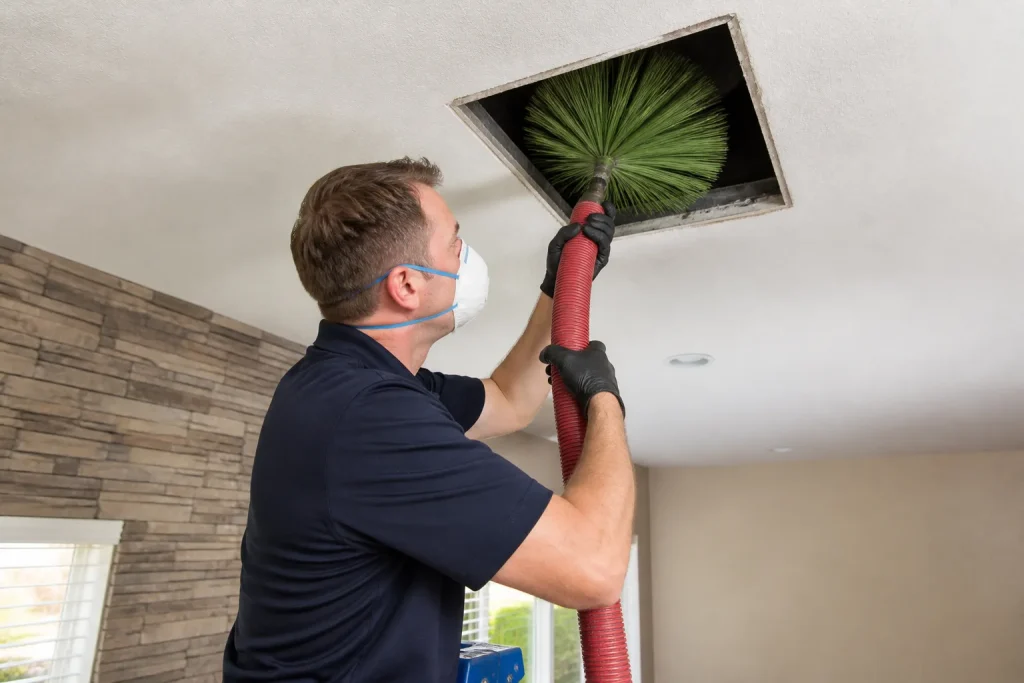
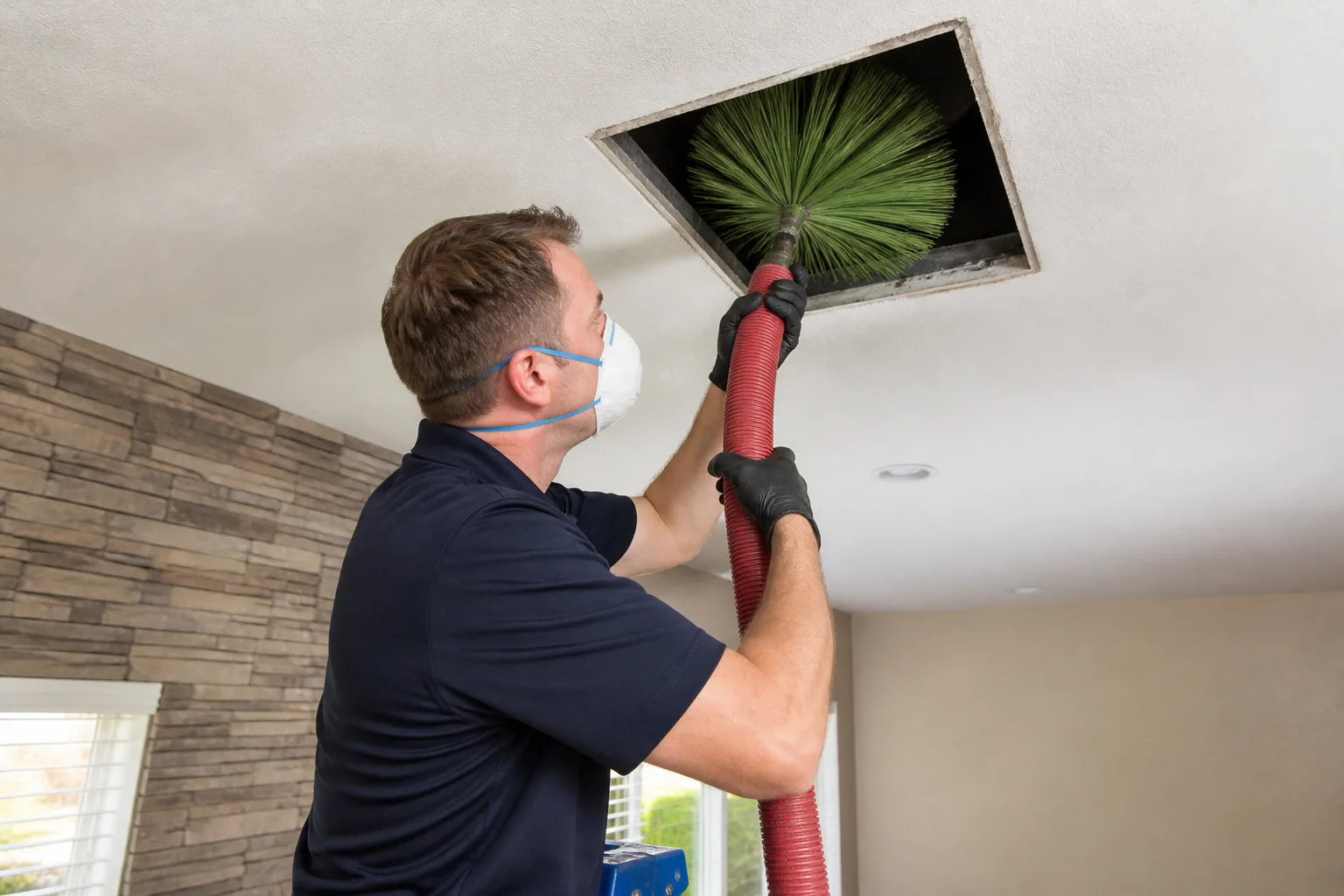
Contact vacuuming means a tool physically touches the inside surface of the duct while suction runs. The tool scrapes, brushes, or whips the wall as it moves, lifts the debris that’s adhered there, and the vacuum captures it. Nikro’s lineup is built around that approach, and it’s the same method Rotobrush equipment is engineered for. Both get material off the duct walls and into a collection system.
Blow-and-go is different. A machine forces air through the system without sealing it, or without tools that agitate surfaces, and the debris has to go somewhere. Too often that somewhere is the registers, the return, and the rooms you just cleaned. A few days later a homeowner notices dust settling on furniture and assumes the ducts are still dirty. In a way they’re right. The debris was never removed. It was relocated.
Here’s the test. Ask any company two questions before they start:
- How is the system sealed during the work?
- Which tools physically agitate the duct walls, and how are they driven through the length of the run?
Answers that name specific tools and describe sealing are a good sign. Answers that talk around the equipment are not.
Why does commercial-grade equipment matter in a Spokane Valley home?
Commercial-grade equipment exists to handle volume and long runs, and that’s precisely why it matters in a residential setting. Many Spokane Valley homes have longer duct runs than a buyer expects, especially houses with a finished basement or a second story, plus trunk lines that run the width of the house before branching. Longer runs mean more duct surface, more sediment, and more distance for the vacuum to pull air through. A small portable unit struggling to maintain suction across a long trunk line will lose capture efficiency at the far end. The technicians tend to compensate by spending less time on the runs they can’t reach well.
Matching a machine to the system also matters in this climate. Spokane Valley summers run hot and dry, with dust from surrounding prairie and gravel to match, and that dust gets pulled into return ducts month after month. Winters bring months of running the furnace with the house closed up. A system that captures dust properly during those months is doing more work than a machine that only extracts what’s loose on the surface. Professional-grade equipment, residential pricing – that’s the balance to look for.
We run Nikro and Rotobrush systems because they’re built for this kind of sustained pull, and because they give us the option to repair a duct system when the cleaning reveals a failure. We don’t just clean your ducts – we inspect and repair them. The same tools commercial contractors rely on, in your home. If a trunk line is crushed, disconnected, or leaking, cleaning it without fixing it means the problem returns with the next heating season.
What questions should you ask a duct cleaning company about equipment?
Ask about the model. Not the brand name dropped in a brochure line – the actual machine and tool set they plan to bring into your house. A company that uses professional equipment knows its models and specs, because that’s what they bought and maintain. A company that outsourced the work to a subcontractor won’t know the answer, and a company working out of a rented truck likely doesn’t care.
Five questions that separate the two:
- What is the make and model of the vacuum you’ll use, and what’s its CFM rating?
- How do you seal the system, and what do you do to keep dust from entering the living space during the work?
- What tools agitate the duct walls, and how do you verify each run was fully cleaned?
- Will I see the inside of the ducts before and after the work?
- If the cleaning reveals a damaged or disconnected duct, what happens next?
Number five is the one most people skip, and it’s the most telling. A pure cleaning crew will tell you to call a duct repair company. A company set up to clean and repair will offer to fix it. Lockhart Air Duct Cleaning handles both, so the answer doesn’t turn into a second appointment with a second company. That matters more than it sounds, because a duct system that leaks or has a collapsed run doesn’t stop pulling dust into the house between cleanings.
We also work with Honeywell, Aprilaire, Abatement Technologies, and Guardsman product lines. When a return is undersized or a homeowner wants better filtration, we can recommend and install the right air quality equipment in the same visit. That doesn’t happen every time, but when the cleaning turns up a reason for it, the option is already there.
How do you read a duct cleaning proposal and spot a surface-pass job?
The scope of work tells you everything, if it’s written down. A source-removal clean lists which parts of the system are covered – supply runs, returns, trunk lines, registers, furnace or air handler – and what happens to each. A surface-pass job stays vague on purpose. When there’s no written scope, the technician does whatever seems reasonable on the day, and “reasonable” is a moving target.
What a proper written scope should contain:
- A list of every component included: supply registers and runs, return registers and runs, trunk lines, and the air handler or furnace cabinet if that’s covered.
- The equipment being used, including the vacuum and the agitating tools.
- Whether the system will be sealed and how dust escape is prevented.
- What happens if damage is discovered – who fixes it, and whether it’s priced separately.
- Whether before-and-after photos are part of the job.
The price should be one flat figure per system agreed before work starts, not a per-vent quote that grows as the technician counts registers. If the quote arrives as a low number on the phone and then a bigger number on the invoice, ask why before you pay. And ask for the photos. If the work was actually done, the company should be able to show what the ducts looked like before and after. Before-and-after photos of your own system are the most honest documentation you’ll get.
When to call a pro
Some signs point to a professional visit rather than a hardware store run:
- Visible dust puffing out of registers when the furnace kicks on.
- A musty or stale smell that returns each time the system runs.
- Noticeable dust settling on surfaces days after cleaning a room.
- Uneven airflow between rooms, or a room that never gets warm.
- A dryer that takes two cycles to dry a load. Dryer lint buildup in the vent line is a documented fire risk, and most duct cleaners treat dryer vent cleaning as an afterthought. We treat it as a dedicated service. That’s a different problem from your air ducts, but the same principle applies: removal, not delay.
If you’d rather not spend the weekend on a ladder peering into a register, call (844) 352-9945. We answer 24/7. Fast dispatch from 7am to 7pm, Sunday through Friday.
Related services in Spokane Valley: air duct cleaning and dryer vent cleaning. Both are available as standalone visits or alongside a repair.
The Bottom Line
Nikro air duct cleaning in Spokane Valley comes down to three things: a sealed system, a machine with enough CFM to hold a pull across your duct runs, and contact tools that physically agitate the duct walls while the vacuum captures what lifts off. That’s what separates a source-removal clean from a surface pass. Ask for the equipment model, ask how the system gets sealed, ask for before-and-after photos, and ask what happens if the cleaning reveals damaged ductwork. A company with professional-grade equipment will answer all four without hesitation.
If you’re in Spokane Valley, Lockhart Air Duct Cleaning offers free estimates and a flat price per system, agreed before work starts. Call (844) 352-9945. We answer 24/7. Fast dispatch from 7am to 7pm, Sunday through Friday.
Frequently Asked Questions
Cost depends on the number of runs, how accessible the system is, and whether repair work is involved, which is why any honest answer is a range rather than a single number. The written estimate sets the final price. It’s one flat figure per system, not a per-vent charge that grows as the technician counts registers. Call (844) 352-9945 for an exact quote. Estimates are free.
Cheap quotes usually reflect less equipment, less time, and a narrower scope. A surface pass with a shop vacuum and a compressed air line costs less to perform than sealing a system and driving contact tools through every run. The low price is real – it just doesn’t buy source removal. Ask what’s included in writing before you compare prices, and you’ll see why the numbers separate.
Before-and-after photos of your own duct system are the clearest evidence. A company that seals the system, uses agitating tools, and captures what it lifts will have no trouble showing you the difference. A company that can’t produce photos is asking you to take the result on faith. Call (844) 352-9945 for a free estimate and ask for the photo documentation up front.
Most homes in Spokane Valley don’t need annual cleaning. Somewhere in the range of every few years makes sense for a typical house, and sooner if you’ve done major remodeling, have pets, or notice dust and airflow problems that persist after cleaning the rooms. Frequent cleaning isn’t a substitute for fixing a damaged or leaking duct system. If airflow is uneven, the ducts need repair, not another pass with a vacuum. Call (844) 352-9945 and we’ll tell you which problem you actually have.
Written by the team at Lockhart Air Duct Cleaning, serving Spokane Valley since 2016.
Need Air Duct Cleaning Help?
Call Lockhart Air Duct Cleaning - licensed & insured, here with fast help in Spokane Valley.
(844) 352-9945